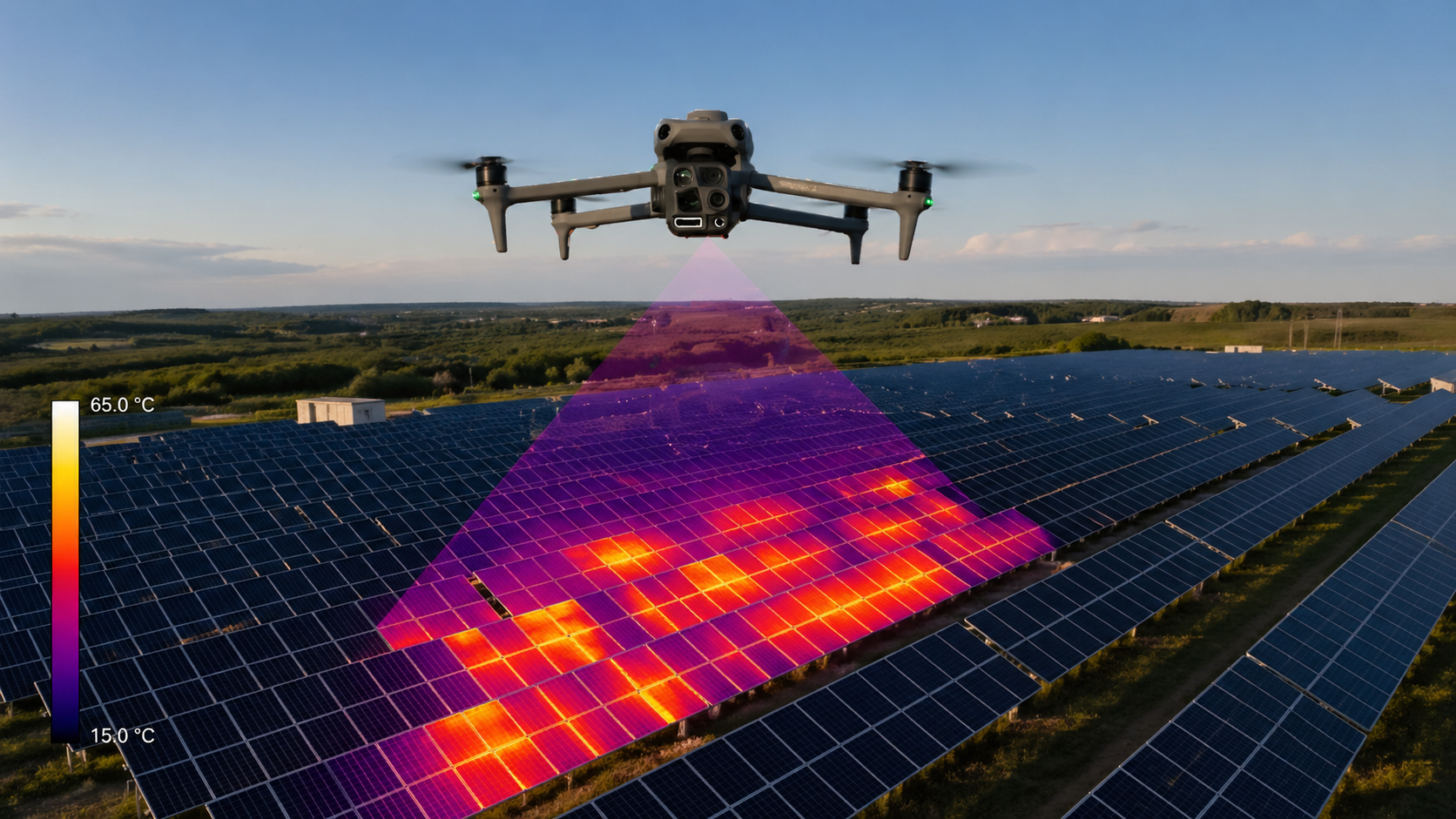
The scenario is frighteningly common in the Solar O&M (Operations and Maintenance) sector: the plant’s Performance Ratio (PR) drops inexplicably. The site manager hires the cheapest outsourced drone pilot to perform a thermal inspection. The pilot delivers a PDF filled with hundreds of “colorful pictures” showing hotspots.
Relieved to have found the problem, the manager contacts the module manufacturer to request the replacement of the defective panels under warranty via an RMA (Return Merchandise Authorization). Weeks later, the manufacturer’s response arrives: Warranty denied. The report is invalid.
Why does this happen? Because in photovoltaic engineering, a thermal photo is not an inspection report. If your data is not strictly aligned with the international IEC TS 62446-3 standard, you do not possess legal proof of the defect; you simply have an expensive photo album.
In this article, Horus explains what the amateur market hides from you and why correct data processing is the only way to avoid losing the warranty on your million-dollar asset.
The “Colorful Photo” Illusion
The popularization of thermal drones has created a false sense of simplicity in the market. There’s a belief that it is enough to fly over the plant, point the thermal camera, and look for bright or reddish pixels on the screen. The problem is that solar module manufacturers do not replace equipment based on colors. They require absolute radiometric data.
An unqualified pilot generally commits three fatal errors that invalidate any report:
- Ignoring Environmental Conditions: Flying under a cloudy sky or with inadequate solar irradiance.
- Incorrect Capture Angle: Taking photos completely perpendicular (90º) to the panel, which causes thermal reflection of the drone itself, masking actual defects.
- Lack of Calibration: Delivering images in a simple JPG format, where the heat is merely a digital painting, lacking the temperature metadata embedded in each pixel (R-JPEG).
If your current report only has photos pointing out the error without proving how that error was measured, it will be rejected in the manufacturer’s very first technical audit.
What is the IEC TS 62446-3 Standard?
IEC TS 62446-3 (Photovoltaic systems – Test requirements, documentation and maintenance) is the global “rulebook” for outdoor thermographic inspections of solar plants. For a top-tier manufacturer to accept your RMA request, your report must provide documentary evidence that the flight met stringent requirements, such as:
- Minimum Solar Irradiance: The inspection is only valid if the Global Horizontal Irradiance (GHI) at the time of flight is above 600 W/m². Without enough energy flowing, anomalies do not heat up sufficiently for an accurate diagnosis.
- Wind Limits: Winds exceeding 28 km/h cool the surface of the module (convection), concealing critical hotspots.
- Spatial Resolution: The drone must fly at an altitude and speed that ensure each solar cell is represented by a minimum number of pixels on the thermal camera sensor.
- Anomaly Distinction: The report must use correct temperature gradients (Delta T) to prove whether the anomaly is a physical defect in the module, an activated bypass diode, or merely temporary shading.
The “Hidden Cost” of the Cheap Pilot
Hiring the cheapest inspection is incredibly expensive. Let’s assume you saved a few thousand by hiring a freelancer with no engineering background to inspect a 10 MW plant. His report finds 200 modules with Sub-String overheating (a classic diode defect covered by factory warranties).
Because the flight did not follow the IEC standard, the manufacturer rejects the replacement. The cost for you to buy those 200 modules out of pocket and pay the field team to replace them can easily exceed BRL 100,000. Your initial BRL 5,000 savings just cost you the equivalent of months of revenue in lost energy generation and spare parts.
The Horus Solution: Technical Compliance and Operational Agility
At Horus Smart Detections, we do not deliver a “colorful PDF.” We deliver an auditable diagnosis that shields your operation against manufacturer denials. The technology behind our software and our Artificial Intelligence was developed with the guidelines of IEC TS 62446-3 at its very core.
Horus strictly applies and respects this standard when requested by the client, acting strategically during the plant’s commissioning or first inspection. The goal is to certify that the asset was delivered 100% functional or, if it wasn’t, to generate the exact evidence needed to trigger the warranty immediately.
The Agile Methodology for Periodic Inspections
We know that day-to-day Operations and Maintenance (O&M) requires dynamism. Therefore, for routine periodic inspections—where the primary goal is monitoring plant health rather than filing a warranty claim—Horus has developed a more agile proprietary methodology.
This optimized approach drastically reduces flight time and fieldwork, as well as the data processing time on our platform. The result is a much faster delivery of reports to the client, guaranteeing an impressive 99.7% accuracy in anomaly detection.
Whether through flights executed by our team or by processing data captured by your internal fleet, we ensure the cycle is completed with technical certainty:
- Intelligent Thermal Context: Our Artificial Intelligence reads radiometric data, not color. It instantly differentiates between Soiling, PID (Potential Induced Degradation), or a Cracked Cell.
- Intact Metadata: We preserve the traceability of the thermal image, allowing the manufacturer’s engineering team to verify the exact temperature of the hotspot and the Delta T.
- Manufacturer-Ready Reports: The system generates standardized reports that already contain the information required by warranty audits, detailing the fault’s severity, exact GPS location, and generation loss calculation (ROI).
Don’t Gamble with Your Asset’s Warranty
The thermal inspection of a photovoltaic plant is a diagnostic engineering process, not an aerial filming service. If your current workflow cannot prove the environmental conditions, sensor resolution, and radiometric accuracy required by IEC TS 62446-3, your plant is operating in the dark, and your warranty is an illusion.
Stop hoarding legally void data. Talk to the Horus team today and discover how our software ensures report compliance and maximizes your plant’s revenue recovery.