When the Engineering or Security department presents a project to implement an autonomous drone fleet, the technical argument is undeniable: the technology reduces inspection time, increases human safety, and cuts operational bottlenecks.
However, when the project lands on the Chief Financial Officer (CFO) or Procurement department’s desk, the conversation shifts from megapixels and software to Total Cost of Ownership (TCO), Depreciation, and Cash Flow.
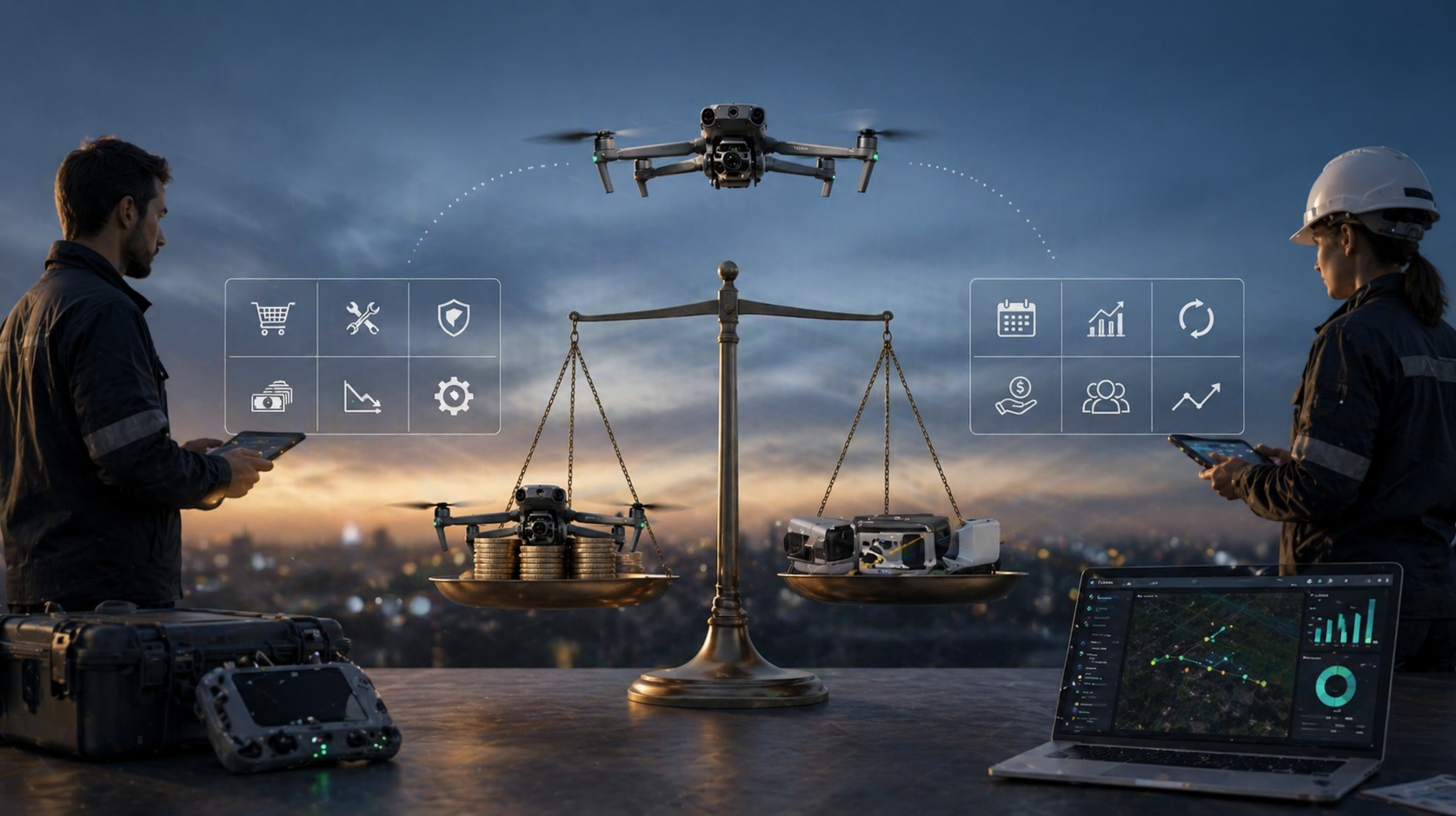
The decision to scale drone usage in large corporations inevitably hits the classic financial crossroads: should we acquire the fleet (CAPEX) or contract the technology as a service (OPEX)?
In this article, Horus Smart Detections analyzes the pros and cons of each model in the Enterprise Drone market, helping your C-suite choose the financial vehicle that best protects cash flow and maximizes operational ROI.
The CAPEX Route: The Weight of Ownership
The CAPEX (Capital Expenditure) model involves the outright purchase of hardware (drones, Dock stations, batteries) and perpetual software licensing.
For a long time, this was the standard in heavy industry. Buying assets means increasing the company’s equity. However, when dealing with cutting-edge technology, hardware behaves very differently from a tractor or industrial machinery.
The Risk of Capital Lock-up and Obsolescence
- Rapid Depreciation: Drone technology evolves at a breakneck pace (comparable to smartphones or enterprise servers). Top-tier equipment bought today can become outdated in 36 months. By locking up capital, the company fully absorbs the cost of this obsolescence.
- Hidden Maintenance Costs: In the acquisition model, after the factory warranty expires, your company is responsible for preventive and corrective maintenance costs, propeller replacements, and battery lifecycle replenishment (which are expensive consumable items).
- The CAPEX Advantage: If your company has robust capital budgets, tax benefits tied to asset depreciation, or strict compliance rules prohibiting the leasing of critical infrastructure, outright acquisition remains the most viable path.
The OPEX Route: Technology as a Service (DaaS and SaaS)
The OPEX (Operational Expenditure) model transforms the acquisition cost into a predictable monthly fee. It is the transition from “ownership” to “access.”
In the drone market, this translates to DaaS (Drone as a Service) and SaaS (Software as a Service) models. Instead of buying the equipment and the AI platform, your company pays a monthly or annual subscription to utilize the entire ecosystem.
Shielding the Cash Flow
- Capital Preservation: OPEX prevents immediate capital lock-up. The millions that would be spent purchasing a fleet of 10 autonomous drones can be reinvested into the company’s core business (plant expansion, new hires, etc.).
- Absolute Predictability: TCO (Total Cost of Ownership) shifts from an estimate to a fixed contract. Costs for maintenance, insurance, battery replacement, and software updates are already diluted into the monthly fee. There are no operational “surprises.”
- Continuous Technological Upgrades: In the service model, at the end of the contract cycle (e.g., 24 or 36 months), the company can renew the fleet and receive next-generation equipment, ensuring the operation never runs on obsolete technology.
- Tax Benefits: In most corporate tax regimes, OPEX expenses can be written off as operating costs, directly reducing the taxable income base, which ultimately improves the company’s EBITDA.
The Dilemma: Which Model to Choose?
The answer isn’t technological; it is strictly strategic and accounting-based.
- Choose CAPEX if: Your company has high cash availability, a clear accounting strategy for the rapid depreciation of technological assets, and already possesses a robust internal maintenance and fleet management department.
- Choose OPEX if: The goal is to preserve cash flow, ensure monthly predictability, keep technology constantly updated, and transfer hardware maintenance and obsolescence risks to a specialized partner.
The Commercial Flexibility of Horus
At Horus Smart Detections, we understand there is no financial “cookie-cutter” recipe that fits every multinational. Our mission is to deliver data intelligence (cost reduction in inspection and security), regardless of the procurement vehicle.
Therefore, we offer a hybrid commercial model adaptable to your C-suite’s Procurement rules:
- Traditional Sale (CAPEX): As an Official DJI Enterprise Reseller, we supply the hardware billed directly to your company, coupled with perpetual or annual licensing of our Monitora AI Platform.
- Service Model (DaaS / OPEX): We provide the complete ecosystem—the drone, the autonomous DJI Dock, insurance, batteries, and the Horus software license—bundled into a single monthly service contract.
- Bring Your Own Device (Pure SaaS): Has your company already purchased drones in the past? No problem. We keep your CAPEX intact, and you only contract our Artificial Intelligence processing (Monitora Platform) under the SaaS (OPEX) model, bringing your current fleet’s data to life.
The Next Step
Do not let budget barriers paralyze your operation’s innovation and efficiency. Horus’s technology was developed to pay for itself rapidly, regardless of the chosen accounting model.
Bring your Engineering team and your CFO to the same table. Contact us and let us design the perfect Business Case and financial modeling to scale your drone fleet without compromising your balance sheet.