When managing large perimeters—such as industrial plants, logistics hubs, power plants, and railways—traditional private security has hit an efficiency ceiling. The model based on a massive allocation of human capital (physical guards and patrol vehicles) is not merely flawed from a tactical perspective; it has become an unsustainable financial liability.
We are entering the era of Perimeter Security 4.0, where the response to intrusions shifts from reactive and blind to predictive, autonomous, and data-driven. In this article, we open the “black box” of your operation’s security costs and draw a direct comparison: how much your company is losing today by maintaining mobile physical posts versus the Return on Investment (ROI) of implementing an autonomous station like the newly released DJI Dock 3.
The Illusion of Security and the Hidden Cost of Physical Posts
Many Security Directors and Facility Managers believe that keeping a patrol vehicle circling the perimeter 24 hours a day is the pinnacle of prevention. However, mathematics and human biology prove otherwise. To maintain a single 24/7 mobile patrol unit, a company requires:
- A rotation of at least 4 security guards (to cover 24/7 shifts).
- A marked patrol vehicle.
- Continuous fuel, maintenance, and fleet depreciation costs.
The Financial Drain (OPEX)
In the Brazilian market, the actual monthly cost of a 24-hour armed mobile post (including salaries, payroll taxes, benefits, outsourced management fees, and fleet costs) ranges between BRL 35,000 and BRL 45,000.
The Cost of Risk (Liabilities and the Line of Fire)
- Fatigue and Night Blindness: The human brain loses focus after just a few hours on patrol. At night, human vision is practically useless beyond the reach of the vehicle’s headlights.
- Predictability: Intruders study the vehicle’s patrol timing and exploit the “blind window” between rounds.
- Labor Liabilities and Life Risk: Sending a guard to investigate a perimeter alarm in the dark exposes the company to immeasurable risk (from workers’ compensation lawsuits due to accidents to fatalities in armed confrontations).
The Automation Answer: The DJI Dock 3 “Watchman”
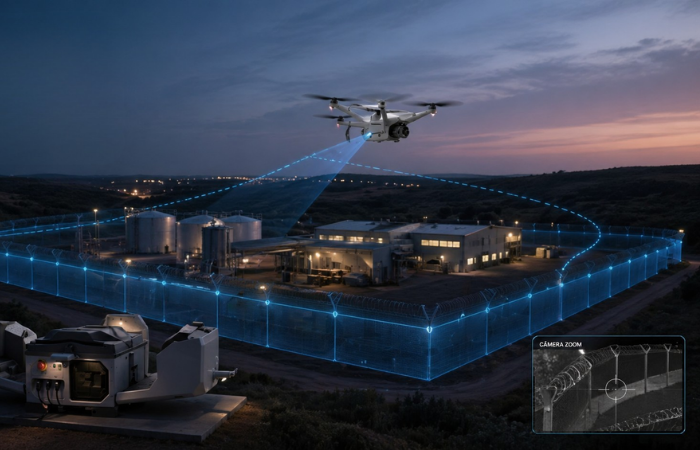
To solve human inefficiency, advanced robotics combined with Artificial Intelligence has taken center stage. Released in early 2025, the DJI Dock 3 is DJI’s premier “Drone in a Box” solution, optimized for both fixed deployments and vehicle mounting, enabling uninterrupted (24/7) remote operations. Unlike a human, the machine does not sleep, does not feel fear, and can see the invisible.
By acquiring the equipment through Horus, your team receives comprehensive training to operate the platform independently. Integrated with DJI’s native FlightHub 2 software, you gain an autonomous aerial surveillance post with military-grade specifications:
- Immediate Rapid Response: In the event of a perimeter alarm, the drone takes off in just 10 seconds, arriving at the incident location far faster than any ground vehicle.
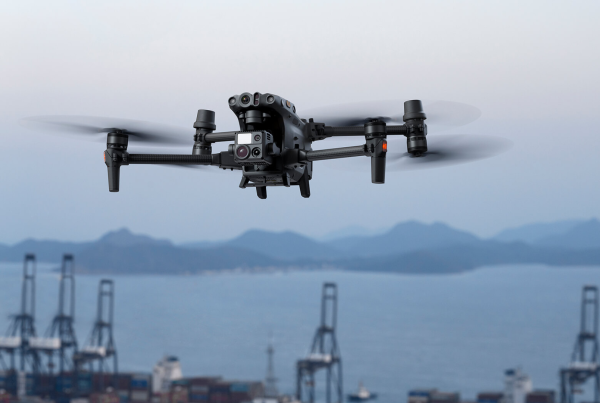
- Vision Beyond Darkness: The DJI Matrice 4TD drone, paired with the Dock 3, features thermographic cameras and an IR-Cut filter, delivering crisp black-and-white night vision. It can detect an intruder’s body heat from hundreds of meters away, even if they are camouflaged in dense vegetation.
- Extreme Climate Resilience: Operations do not stop for bad weather. The DJI Dock 3 is IP56-rated against water and dust, while the Matrice 4TD is IP55-rated. The system operates flawlessly in extreme temperatures (-30°C to 50°C) and withstands wind speeds up to 12 m/s.
- High Endurance: The drone achieves up to 54 minutes of flight time, and upon returning to base, its batteries rapid-charge from 15% to 95% in an impressive 27 minutes.
Financial Comparison: Manual Patrols vs. Automation (ROI)
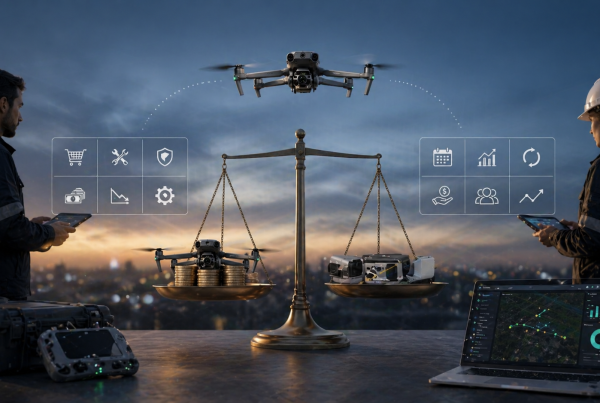
The argument that “drone technology is expensive” falls apart when weighed against the continuous OPEX of a physical security post. Let’s analyze the Business Case of replacing just 1 Mobile Post (24/7 Patrol Vehicle) by implementing the DJI Dock 3, operated by your own in-house team.
The Payback Mathematics
| Cost Description | Mobile Patrol Post (Manual) | DJI Dock 3 (Autonomous) |
| Monthly Cost (OPEX) | BRL 40,000 (Outsourcing + Fleet) | Drastic reduction (Marginal energy & connectivity only) |
| Cumulative Cost (1 Year) | BRL 480,000 | BRL 0.00 (No extra guard salaries) |
| Initial Investment (CAPEX) | BRL 0.00 (Absorbed by the outsourced firm) | Hardware + Implementation & Training costs |
| Nighttime Detection Rate | Low (Depends on headlights and human focus) | 100% (Native thermal reading) |
| Response Time | 5 to 15 minutes (Ground travel) | < 1 minute (10s takeoff + straight-line flight) |
The ROI Verdict: Even when accounting for the maximum initial CAPEX to acquire cutting-edge hardware and training, the autonomous DJI Dock 3 system pays for itself entirely within 6 to 8 months (Payback). From the 9th month onward, the BRL 40,000 that would have been paid to the security firm transforms directly into net savings (profit) for your company’s cash flow. Over a 3-year period, the savings exceed BRL 1 Million per substituted post.
Beyond Financials: Loss Prevention and ESG Compliance
Replacing humans with robots for repetitive and dangerous tasks goes beyond financial savings; it is a matter of Corporate Governance and Risk Mitigation (ESG). With the implementation of the DJI Dock and the specialized training provided by Horus:
- Taking Humans Out of the Line of Fire: In the event of an armed intrusion, the tactical team (Security Operations Center) receives real-time footage of the threat and dispatches law enforcement with exact GPS coordinates, without exposing a worker to lethal risk.
- Native Intelligence and Auditing: Unlike a paper logbook, every flight generates unalterable reports. The AI embedded within DJI’s systems automatically detects and classifies unauthorized “Vehicles” and “People” in real time.
- Regulated Scalability: With the latest ANAC (Civil Aviation Authority) guidelines in effect, Horus delivers the solution fully compliant for BVLOS (Beyond Visual Line of Sight) flights, legally allowing your team to control the perimeter of a solar plant in the state of Bahia from a command center in São Paulo.
It Is Time to Stop Paying for Inefficiency
Maintaining manual patrols to guard vast perimeters in the 21st century is the equivalent of using oil lamps in the LED era. Automation hardware has reached maturity, and data intelligence software has bridged the operational gap.
If your perimeter security budget is high, yet your facility continues to suffer from cable theft, intrusions, and false alarms, the problem is not a lack of investment—it is capital allocated to the wrong model. Do not wait for the next major breach to modernize your security architecture.
Speak with Horus’s Specialists and schedule a free diagnostic. We will build the exact Business Case for your operation and demonstrate how deploying autonomous Docks, paired with our advanced training, will reduce your risk to zero and cut your OPEX in half.