Purchasing a drone from the DJI Matrice line (such as the Matrice 4T or the Matrice 400) is a milestone in the modernization of any engineering, security, or energy operation. However, many managers discover the hard way that signing the purchase order is only 20% of the job. The other 80% determines whether this equipment will transform your productivity or turn into an incredibly expensive paperweight on a shelf.
In high-performance unmanned aviation, the transition between receiving the box and having the drone safely executing autonomous missions requires a structured process. This is where Onboarding and Specialized Training separate successful operations from those plagued by crashes and inaccurate data.
In this article, we detail the Horus implementation workflow and explain why training is the linchpin for your fleet’s ROI.
The “Box Selling” Trap in the Drone Market
One of the biggest mistakes in acquiring Enterprise Drones is treating the equipment like a standard consumer electronic. Volume-focused suppliers hand over the hardware and disappear. The immediate result for the client’s operation usually involves:
- Crash Risks: Inexperienced pilots operating 5 to 10 kg equipment near critical infrastructure.
- Useless Data: Flights executed without the correct image overlap or RTK precision, generating maps that do not align with the topography.
- Technological Underutilization: The drone is only used to “take pictures,” ignoring the full potential of autonomous missions, thermal sensors, and AI processing.
To mitigate these risks, the acquisition of Enterprise-grade equipment must obligatorily be accompanied by a technology transfer program.
The Horus Onboarding Workflow: From Unboxing to Artificial Intelligence
As an official distributor and solutions integrator, Horus does not just deliver hardware; we deploy operational capability directly into your team. Our Onboarding process is divided into 4 critical stages:
1. Activation and Compliance (Initial Setup)
Before the drone ever goes to the field, our technicians perform bench preparation.
- Unboxing and Inspection: Verification of all components, batteries, and sensors.
- Firmware Updates: Ensuring the drone, the controller, and the batteries are running the latest, most stable versions recommended by DJI.
- Initial Calibration: Adjusting the compass, IMU, and anti-collision vision systems.
2. Ground School and Regulatory Training
Your team needs to understand the airspace before occupying it.
- Regulation and Safety: Operational best practices and alignment with aviation regulations (such as ANAC and DECEA) for corporate and industrial flights.
- Battery Management (TB30/TB65): How to store, charge, and extend the lifespan of smart batteries, drastically reducing replacement costs.
- Mission Planning: How to evaluate weather, the Kp index (geomagnetic interference), and obstacles before starting the motors.
3. Field Operation and Autonomous Missions (Practical)
The moment to put the equipment in the air under the guidance of certified instructors.
- Emergency Manual Flights: Training the operator to take full control in the event of a GPS failure or severe interference.
- Autonomous Flight Configuration: How to draw mapping polygons, define inspection routes (Waypoints), and set the ideal GSD (Ground Sample Distance) for the project’s required precision.
- Specific Sensor Utilization: Focused training on the correct use of radiometric (thermal) cameras, Laser Rangefinders, and DJI Matrice zoom cameras.
4. Processing and Artificial Intelligence (The Differentiator)
The drone collects the data, but the real value lies in the final deliverable.
- Download and Triage: How to extract data in an organized manner.
- Horus Software Integration: We train your team to upload images to our platform, allowing Artificial Intelligence to detect anomalies (such as hotspots on solar panels or faults in transmission lines) and generate automated reports.
Training as a Cost Reduction Tool (ROI)
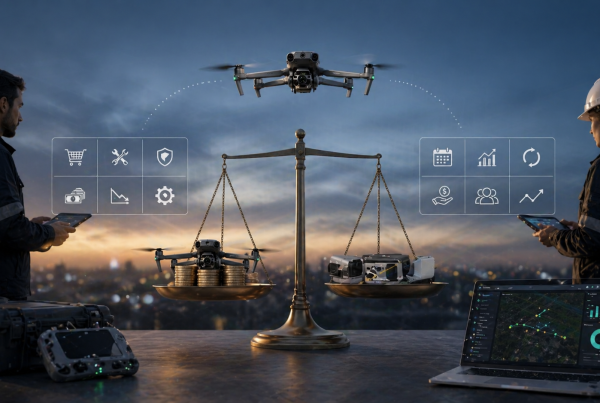
Investing in qualified onboarding is not an extra cost; it is an insurance policy for your operation. Trained pilots reduce downtime, prevent accidents that could cost tens of thousands of dollars in maintenance, and, most importantly, ensure that data collection is done perfectly on the first try, eliminating the need for rework and additional team deployments to the field.
The future of your operation demands end-to-end intelligence.
Do not let your technology investment sit idle due to a lack of capability. Speak with Horus’s specialists and discover how to deploy an Enterprise Drone operation with safety, predictability, and maximum efficiency.