The accelerated expansion of utility-scale solar power plants (PV) in Brazil has brought an inevitable logistical and financial challenge for O&M (Operations and Maintenance) managers: how do you inspect thousands of solar panels quickly, accurately, and without breaking the operational budget?
Manual thermographic inspection—performed by technicians walking under the sun with handheld thermal cameras—has become a severe bottleneck. It is a slow process, highly susceptible to human error, and demands exorbitant labor costs.
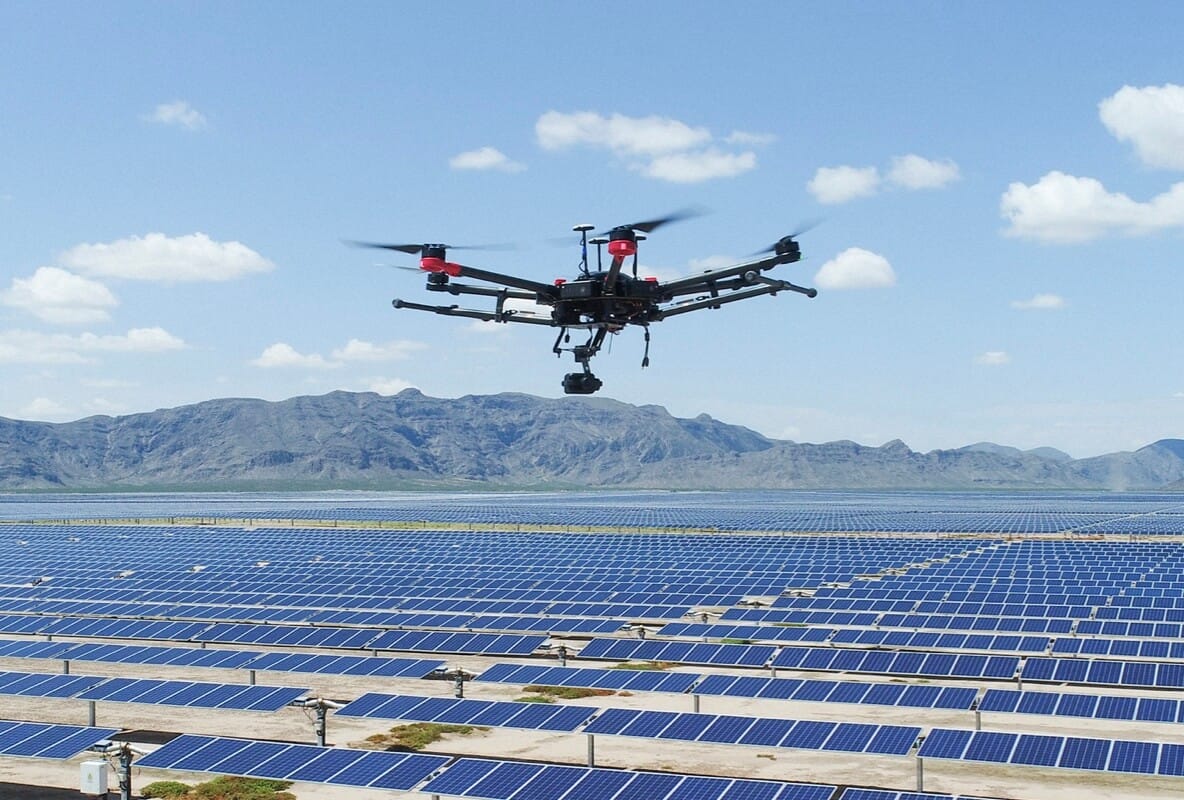
The introduction of Enterprise Drones equipped with radiometric sensors (such as the DJI Matrice 4T or the Matrice 400), paired with Artificial Intelligence software, has completely flipped the sector’s math. In this article, we detail the Return on Investment (ROI) of this technology, comparing costs, timelines, and real efficiency in fault detection.
The Hidden Cost of Manual Inspection
Before calculating the gains from drone adoption, we must understand exactly where traditional inspections lose money.
In a medium to large-scale plant, anomalies such as hotspots, disconnected strings, excessive soiling, or PID (Potential Induced Degradation) are common. When an inspection takes weeks to complete, the plant spends days generating less energy than it was designed to. This generation deficit is a silent cost that rapidly erodes the solar park’s profitability.
Furthermore, the natural variation in solar irradiance over a full day of manual fieldwork heavily affects the readings of ground-based thermal cameras, generating inconsistent reports and a high volume of “false positives.”
Productivity Comparison: Manual vs. Drones
To illustrate the direct impact on both schedule and budget, we put together a comparison considering a standard O&M operation in utility-scale solar plants:
| Operational Indicator | Manual Inspection (Ground Thermography) | Autonomous Drone Inspection (e.g., DJI Matrice 4T) |
| Collection Speed | 2 to 3 MW inspected per day | 15 to 25 MW inspected per day |
| Team Size | 2 to 3 technicians in the field | 1 drone pilot |
| Data Quality | Inconsistent (depends on the angle and irradiance at the moment) | Standardized (90º angle, constant altitude and speed) |
| Report Generation | Manual, taking weeks to tabulate data | Automated via AI (Horus) in a few hours |
| Occupational Risk | High (heatstroke, venomous animals, fatigue) | Practically Zero (remote operation from the base) |
How to Calculate Aerial Inspection ROI
The Return on Investment in acquiring a drone fleet (or contracting aerial photogrammetry services) is anchored on three financial pillars:
1. Drastic Reduction in Labor Cost
A 50 MW inspection can take more than 20 days to be completed by a ground team. With a drone like the DJI Matrice 4T executing autonomous grid missions, that exact same park is mapped in 2 to 3 days. The immediate reduction in per diems, hotel stays, transportation, and overtime pay rapidly covers the cost of adopting the technology.
2. Energy Recovery (Generation)
The biggest source of ROI is not what you save on the inspection itself, but what you stop losing in generation. By identifying thermal faults in a matter of hours (rather than months), maintenance teams can act surgically. Replacing a defective module or reconnecting a string rapidly elevates the plant’s Performance Ratio (PR), injecting immediate revenue directly into your cash flow.
3. The Artificial Intelligence Factor
Capturing thermal images is only the first stage. The modern bottleneck is analyzing thousands of those images. This is where the complete ecosystem comes in: the images captured by the drones are uploaded to the Horus software platform. The Artificial Intelligence sweeps the thermal orthomosaics and automatically identifies, classifies, and georeferences each anomaly. The manager receives a PDF report with the exact GPS coordinates of each defective panel, optimizing the workflow of the maintenance team—who now goes to the field only to repair, never to search.
The Strategic Decision
Continuing with manual inspections in commercial-scale solar plants is no longer a matter of preference; it is a calculated loss of profitability. The use of Enterprise Drones transforms preventive maintenance by delivering speed, millimeter precision, and highly actionable data.
This transition demands the right equipment, proper training (Onboarding), and a software platform capable of heavy data processing. As an official DJI Enterprise partner in Brazil, Horus delivers the end-to-end solution so that your solar operation can reach its absolute maximum level of efficiency.